
Why Quality Control Starts Before Production Begins
Why Quality Control Starts Before Production Begins
Many activewear brands think quality control begins when finished garments reach the inspection table.
At that stage, inspectors check measurements, stitching, color, logos, labels, and packaging. Defective products are repaired, separated, or rejected before shipment.
Final inspection is important, but it is not the beginning of quality control.
In professional activewear manufacturing, quality control starts much earlier—before the bulk fabric is cut and before the sewing line begins production.
It starts when the brand defines the product requirements.
It continues through fabric selection, pattern development, sample testing, measurement confirmation, logo approval, and pre-production planning.
The reason is simple: final inspection can identify a problem, but it may be too late to correct it efficiently.
If the wrong fabric has already been cut, the entire order may be affected. If the approved size chart is inaccurate, hundreds of garments may be produced with the wrong fit. If the logo application is incompatible with the fabric, the problem may appear across every finished piece.
Strong quality control therefore focuses on prevention, not only detection.
Final Inspection Cannot Fix Every Problem
A finished garment inspection can identify visible defects such as:
- Broken or skipped stitches
- Incorrect measurements
- Uneven hems
- Stains or fabric damage
- Misaligned logos
- Incorrect labels
- Loose threads
- Packaging mistakes
Some of these issues can be repaired.
However, many major quality problems cannot be solved through final inspection alone.
For example, an inspector cannot easily change the fabric composition after garments are finished. A poorly developed pattern cannot be corrected without remaking the product. Incorrect color, weak stretch recovery, excessive shrinkage, or unsuitable fabric weight may affect the entire production order.
Even when a problem can be repaired, the brand may face:
- Production delays
- Additional labor costs
- Material waste
- Reinspection
- Replacement packaging
- Late shipment
- Higher freight costs
- Missed launch dates
The most effective quality control system identifies these risks before they become bulk production problems.
1. Quality Control Starts with Clear Product Requirements
Before a factory can control quality, it must understand what quality means for the specific product.
A lightweight running T-shirt, compression top, heavyweight hoodie, training short, and tapered jogger all require different performance standards.
The product requirements should clearly define:
- Intended activity
- Target customer
- Fit and silhouette
- Fabric composition
- Fabric weight
- Stretch and recovery
- Moisture-management needs
- Garment measurements
- Construction methods
- Logo application
- Labels and trims
- Packaging requirements
Without clear specifications, the factory may produce a technically acceptable garment that does not match the brand’s expectations.
For example, the phrase “premium fabric” is too general.
One brand may define premium as soft and lightweight. Another may require strong compression and high recovery. A lifestyle brand may prioritize a smooth hand feel and structured drape, while a gymwear brand may focus on durability and moisture management.
Quality control begins by replacing general expectations with measurable standards.
Instead of saying that the shorts should have a comfortable fit, the brand should confirm the waist, hip, rise, inseam, leg opening, waistband height, and measurement tolerance.
Instead of requesting a durable print, the logo method, size, position, color, stretch compatibility, and washing requirements should be confirmed.
The clearer the requirements are, the easier it becomes to control the final result.
2. A Detailed Tech Pack Reduces Production Uncertainty
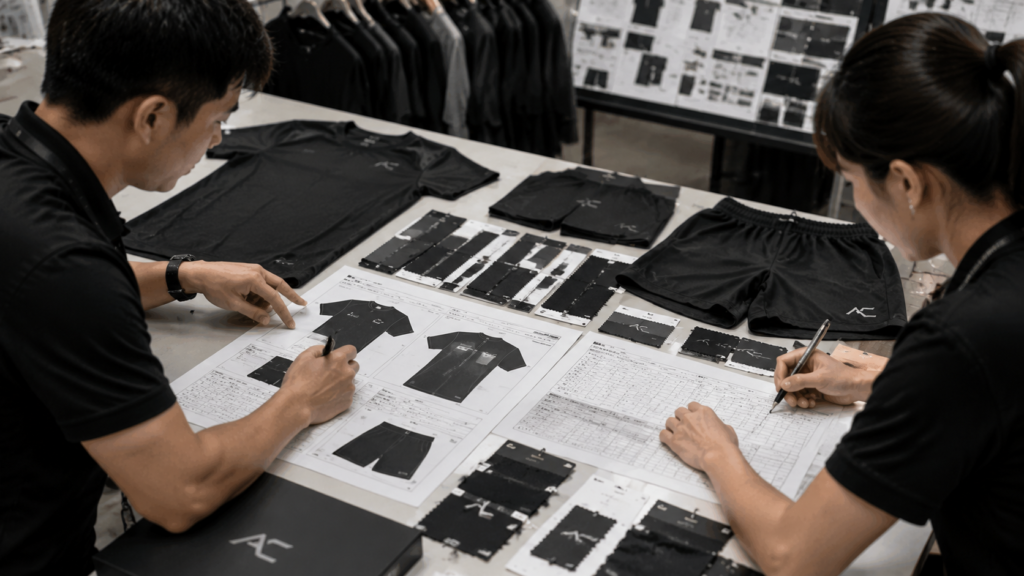
A professional tech pack is one of the most important quality control tools used before production.
It gives the sample room, pattern maker, purchasing team, production supervisor, sewing operators, and inspectors a shared reference.
A useful tech pack may include:
- Front and back technical drawings
- Measurement chart
- Grading rules
- Fabric information
- Color references
- Stitching instructions
- Seam placement
- Logo dimensions
- Logo position
- Label details
- Trim specifications
- Packaging requirements
- Construction comments
When information is missing, different departments may make different assumptions.
The sample maker may interpret the design one way, while the production team interprets it another way. The logo department may use a different placement reference from the quality inspector.
These small differences create inconsistency.
A clear tech pack does not guarantee a perfect product, but it reduces unnecessary interpretation and provides a measurable basis for sample review and bulk inspection.
It also makes revisions easier to manage. When a measurement, logo position, or construction detail changes, the updated requirement can be documented instead of relying on informal messages.
3. Fabric Inspection Must Happen Before Cutting
Fabric quality affects almost every part of the final garment.
It influences comfort, fit, stretch, recovery, opacity, breathability, color, durability, and appearance.
If the material is unsuitable, excellent sewing cannot turn it into a premium activewear product.
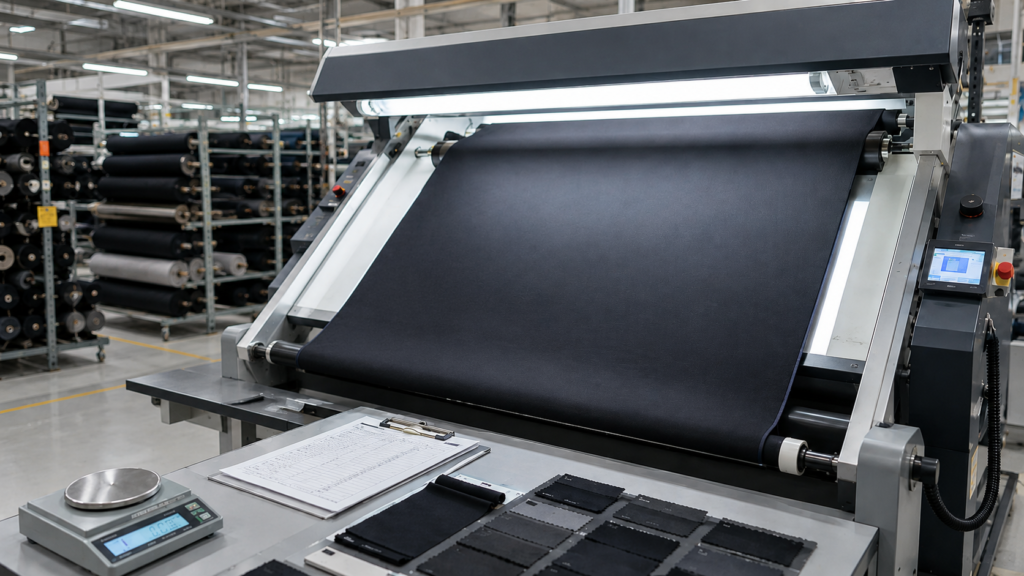
Before bulk production, the factory should confirm important fabric characteristics such as:
Composition and Weight
The fabric composition and GSM should match the approved specification.
A difference in fabric weight can change the garment’s structure, warmth, opacity, stretch, and overall feel.
Stretch and Recovery
Stretch allows the fabric to move with the body. Recovery determines whether it returns to its original shape.
Poor recovery can cause knees, elbows, waistbands, and seat areas to become loose after wear.
Color Consistency
Different dye lots or fabric rolls may contain visible shade variations.
These differences should be identified before cutting so that noticeably different shades are not used within the same garment or production batch.
Shrinkage and Dimensional Stability
Some fabrics shrink, twist, or change shape after washing, steaming, or heat application.
Testing this behavior before production helps the pattern and measurement standards account for expected changes.
Surface Quality
Fabric rolls should be checked for holes, stains, knitting defects, dyeing marks, unwanted shine, pilling, or contamination.
If defective material enters cutting, the problem moves into every following production stage.
Fabric inspection is therefore not only a material check. It is an early quality barrier that protects cutting, sewing, finishing, and final garment consistency.
4. Pattern Development Is Part of Quality Control
A garment can use excellent fabric and still fail because of an inaccurate pattern.
The pattern controls the proportions, shape, movement, seam position, and fit of the product.
For activewear, pattern development must also consider how the body moves during training.
A training T-shirt should allow movement across the shoulders and chest without creating excessive fabric around the waist. Shorts must support squats, lunges, running, and stretching. Joggers need enough space around the hips and thighs while maintaining the intended tapered shape.
The pattern maker must account for:
- Fabric stretch percentage
- Fabric recovery
- Ease allowance
- Intended fit
- Body movement
- Seam position
- Panel shape
- Pocket construction
- Waistband structure
- Size grading
A pattern designed for a stable cotton fabric cannot simply be reused with a highly elastic performance fabric.
The same measurements may produce a completely different fit.
Professional quality control therefore reviews pattern accuracy before bulk cutting. This may involve checking paper patterns, digital measurements, sample fit, garment balance, and movement performance.
Correcting the pattern during sample development is relatively manageable.
Correcting it after hundreds of pieces have been cut is much more expensive.
5. Sample Approval Establishes the Production Standard
The sample is the first physical proof that the product requirements can be turned into a real garment.
It allows the brand and factory to check:
- Fabric suitability
- Fit and proportions
- Garment measurements
- Construction
- Stitching
- Seam placement
- Movement and comfort
- Logo size and position
- Labels and trims
- Overall appearance
A sample should not be approved only because it looks close to the original design.
It should be reviewed as a future production standard.
The brand should test how the garment feels during movement, whether the fabric recovers after stretching, whether the pockets function correctly, and whether the measurements match the size chart.
Clear sample comments are essential.
Feedback such as “make it fit better” is difficult to reproduce consistently. More useful feedback identifies the exact area and required adjustment, such as reducing the body width by one centimeter or increasing the inseam length by two centimeters.
Once all details are confirmed, a final pre-production sample should be approved.
This sample becomes the reference used by the production and quality teams during manufacturing.
If an unresolved problem remains in the approved sample, bulk production may repeat that problem across the entire order.
6. Logo and Trim Testing Prevents Brand-Level Defects
Logos, labels, zippers, drawcords, elastics, buttons, and other trims should also be tested before production.
A logo application that works well on a stable hoodie fabric may not perform correctly on a lightweight stretch T-shirt.
Heat transfers may require specific temperature, pressure, and time settings. Embroidery may pull or distort thin fabric. Reflective and silicone logos need to remain secure during movement and washing.
Before bulk application, the factory should confirm:
- Logo method
- Size
- Color
- Position
- Adhesion
- Stretch compatibility
- Surface appearance
- Washing stability
Trims also affect product quality.
An unstable waistband elastic may twist or lose recovery. A low-quality zipper may become difficult to use. A rough care label may irritate the skin during exercise.
Testing these details before production prevents small components from weakening the entire product experience.
7. A Pre-Production Meeting Aligns Every Department
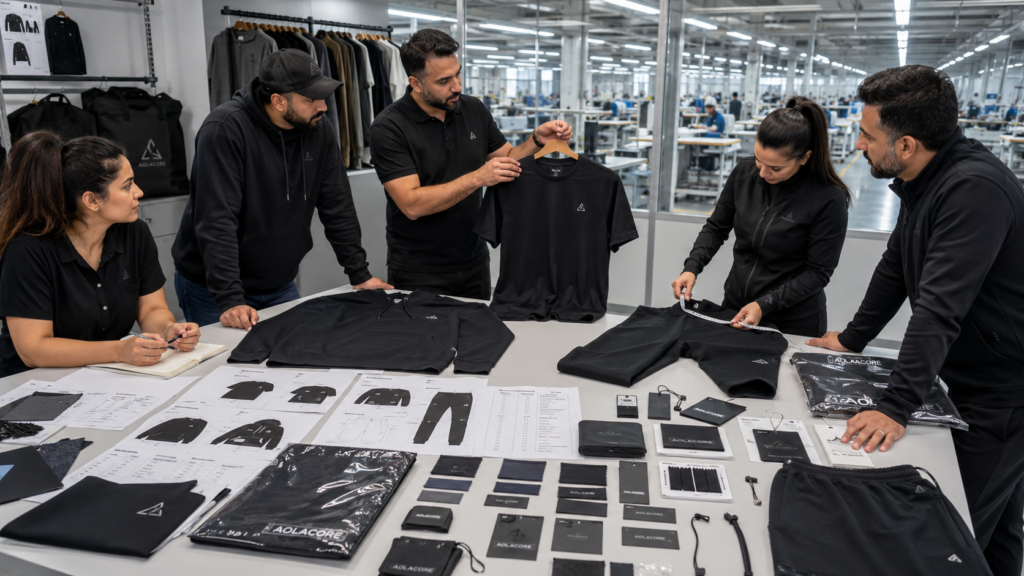
Before cutting begins, professional factories often hold a pre-production meeting.
This meeting connects the development team with the production team.
Participants may include:
- Merchandisers
- Pattern makers
- Sample technicians
- Cutting supervisors
- Sewing supervisors
- Logo technicians
- Quality inspectors
- Packaging teams
The team reviews the approved sample, tech pack, fabric, measurements, construction details, logo application, labels, and packaging requirements.
They may also discuss known production risks.
For example, the sewing team may need to control machine tension carefully on a highly elastic fabric. The cutting department may need to separate different dye lots. The quality team may identify key measurements that require more frequent checking.
This meeting prevents important information from remaining only with the sample room or sales team.
Every department receives the same production standard before work begins.
8. Cutting Accuracy Determines Sewing Quality
Once fabric is cut, many mistakes become difficult to correct.
The cutting team must control:
- Fabric relaxation
- Layer alignment
- Grain direction
- Pattern orientation
- Cutting accuracy
- Shade separation
- Size identification
- Bundle organization
If panels are cut inaccurately, the sewing team may struggle to align seams or maintain measurements.
Incorrect cutting can cause twisted garments, uneven lengths, mismatched panels, distorted pockets, or inconsistent sizes.
Stretch fabrics require particular care because excessive tension during spreading may cause the panels to shrink back after cutting.
Quality control at this stage may include checking the first cut panels against the pattern and confirming that bundles are correctly labeled by style, size, and color.
Preventing a cutting error protects every operation that follows.
9. Early Production Checks Prevent Large-Scale Defects
Even after detailed preparation, the first garments from the sewing line should be inspected carefully.
This is often called a first-piece or initial production check.
The quality team compares the first completed garments with the approved pre-production sample and technical specifications.
They check:
- Measurements
- Stitching quality
- Seam construction
- Logo placement
- Pocket position
- Waistband tension
- Label placement
- Overall appearance
If a problem is found, the sewing line can adjust before producing a large quantity.
For example, an incorrect machine tension may create wavy seams. A waistband may be attached too tightly. A logo guide may position the print too low.
Correcting these issues after ten garments is manageable.
Discovering them after one thousand garments can cause serious rework and delays.
This is why quality control continues throughout production rather than appearing only at the end.
Prevention Costs Less Than Correction
Quality problems become more expensive as production progresses.
An unclear measurement is easy to correct in the tech pack. An inaccurate pattern can be adjusted during sampling. A defective fabric area can be removed before cutting.
Once the same problem has been repeated across hundreds of finished garments, the available solutions become more limited and more expensive.
Preventive quality control helps reduce:
- Material waste
- Rework
- Remakes
- Production delays
- Air freight
- Customer returns
- Negative reviews
- Lost repeat purchases
It also improves communication between the brand and manufacturer.
When standards are confirmed early, both sides can evaluate the finished product against the same requirements.
How AOLACORE Controls Quality Before Production
AOLACORE treats quality control as a complete development and manufacturing system rather than a single final inspection.
Before bulk production, the team works with brands to confirm:
- Product requirements
- Fabric composition and GSM
- Stretch and recovery
- Hand feel and performance
- Pattern and fit
- Garment measurements
- Logo application
- Labels and trims
- Packaging details
- Final pre-production sample
Fabric is evaluated and inspected before cutting. Samples are developed to test the product’s fit, construction, measurements, and performance. Approved samples and technical documents are then used as references during bulk production.
Before the main production line begins, relevant departments review the confirmed requirements and potential manufacturing risks.
During production, AOLACORE conducts quality checks at key stages, including cutting, sewing, logo application, measurements, finishing, and packing.
This multi-stage approach helps prevent small development errors from becoming large production problems.
For brands producing men’s training T-shirts, shorts, hoodies, joggers, compression wear, and other activewear products, early quality control also supports more consistent repeat orders.
The goal is not only to ship one acceptable batch.
It is to establish a clear product standard that can be maintained as the brand adds more colors, sizes, products, and production quantities.
Final Thoughts
Quality control does not begin when the inspector opens the first finished carton.
By then, most of the important production decisions have already been made.
The fabric has been selected. The pattern has been developed. The measurements have been confirmed. The logo has been applied. The garments have been cut and sewn.
Effective quality control begins before these decisions become difficult and expensive to change.
It starts with clear requirements, accurate technical documents, suitable fabric, professional pattern development, complete sample review, and pre-production confirmation.
Final inspection remains essential, but it should be the last step in a much larger quality system.
A professional activewear manufacturer does not simply search for defects at the end.
It builds quality into the product from the beginning.
Build Quality into Your Next Activewear Collection
AOLACORE supports activewear brands through fabric development, pattern making, sample production, pre-production approval, OEM/ODM manufacturing, private labeling, multi-stage inspection, packaging, and shipment.
By confirming quality standards before bulk production begins, brands can reduce manufacturing risks and create more consistent products for their customers.
Are you looking for reliable manufacturers of clothing products?
We can quickly provide customers with market analysis, technical support and customized services.