
Why Consistency Matters More Than Low Prices in Activewear Manufacturing
Why Consistency Matters More Than Low Prices in Activewear Manufacturing
Price is one of the first questions most activewear brands ask a manufacturer.
What is the unit cost? Can the factory offer a lower quotation? How much can be saved by increasing the order quantity or changing the fabric?
These are reasonable questions. Every brand needs to control product costs and protect its profit margins.
However, the lowest quotation does not always produce the lowest total cost.
If fabric quality changes between orders, measurements become inconsistent, colors vary across batches, or workmanship declines during larger production runs, the brand may spend far more correcting those problems than it saved on the original unit price.
For a growing fitness apparel brand, manufacturing consistency is often more valuable than a small price difference.
Customers expect the same size, fit, fabric feel, color quality, and performance every time they purchase. When a manufacturer can maintain those standards from the approved sample to bulk production—and from the first order to future reorders—the brand can grow with greater confidence.
Low Price and Good Value Are Not the Same
A low price can be attractive because the saving is immediate and easy to calculate.
Consistency creates value in a different way.
Its benefits appear throughout the product lifecycle:
- Fewer defective garments
- Fewer customer complaints
- Lower return and exchange rates
- More reliable product reviews
- Easier repeat ordering
- More accurate inventory planning
- Stronger customer trust
- More stable brand positioning
These advantages may not appear directly on a factory quotation, but they have a major influence on profitability.
Imagine that two manufacturers quote the same training T-shirt.
The first supplier offers a slightly lower unit price, but the bulk fabric feels thinner than the approved sample. Some sizes are larger than expected, the logo position varies, and the second order does not match the first.
The second supplier charges slightly more but maintains the approved fabric, measurements, color, construction, and packaging across production batches.
The first option appears cheaper during purchasing.
The second may be more profitable after production, sales, returns, customer service, and reorders are considered.
The correct comparison is therefore not only the price per garment.
Brands should compare the total cost of creating a reliable product.
1. Fabric Consistency Protects the Product Experience
Fabric is one of the first things customers notice.
They may not know the fiber composition, GSM, knitting structure, or finishing method, but they can feel whether the material is soft, structured, breathable, compressive, lightweight, or durable.
When a brand approves a fabric during sample development, that material becomes part of the product promise.
Problems begin when bulk production or later reorders use a fabric that is only technically similar.
The composition may appear the same on paper, but the fabric could have a different:
- Weight
- Hand feel
- Surface appearance
- Stretch percentage
- Recovery
- Opacity
- Color
- Moisture performance
- Pilling resistance
- Washing stability
For example, two fabrics may both be described as polyester-spandex, but one may feel smooth and stable while the other feels thin, shiny, or rough.
A customer who loved the first order may be disappointed when the second version feels different.
Fabric inconsistency can also affect garment fit. A material with stronger recovery may make the same pattern feel tighter. A lighter or softer fabric may create a looser silhouette, even when the garment measurements remain unchanged.
This is why reliable activewear manufacturing requires more than recording fiber percentages.
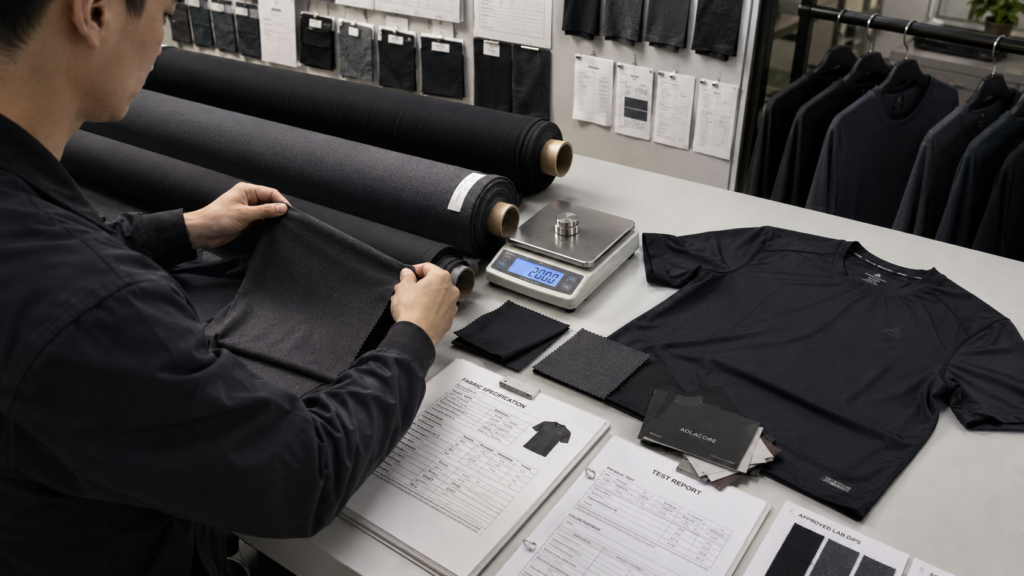
The manufacturer should maintain approved fabric specifications, reference swatches, color information, weight, hand feel, stretch, recovery, and performance requirements.
2. Stable Sizing Reduces Returns and Customer Confusion
Customers expect a medium to fit like a medium.
If they purchase a training T-shirt and later reorder the same product in another color, they should not receive a garment that is noticeably wider, shorter, tighter, or longer.
Sizing inconsistency can result from several production issues:
- Inaccurate pattern grading
- Fabric stretch differences
- Cutting errors
- Sewing tolerance problems
- Incorrect elastic tension
- Poor measurement control
- Shrinkage during finishing
- Unapproved changes between batches
Even small differences can affect activewear because fit is connected to movement and performance.
Shorts that are slightly too tight around the hips may restrict squats and lunges. A loose waistband may move during running. A compression top that becomes wider in larger sizes may lose its intended support.
The direct costs of inconsistent sizing include returns, exchanges, replacement shipping, warehouse handling, and customer service.
The indirect cost is lower customer confidence.
When customers are unsure which size to order, they may purchase multiple sizes and return the unwanted pieces. They may also avoid buying a new style because they no longer trust the brand’s size chart.
Stable sizing makes purchasing easier.
It allows the brand to create a recognizable fit system across T-shirts, shorts, hoodies, joggers, and compression products.
3. Consistent Workmanship Supports Premium Positioning
Premium activewear is judged through details.
Customers notice whether seams are straight, hems are balanced, pockets are aligned, waistbands remain stable, and logos are positioned correctly.
A single minor defect may not destroy the product experience. However, repeated variation makes the brand feel less professional.
Common workmanship inconsistencies include:
- Different stitch density between garments
- Uneven seam allowances
- Wavy hems on stretch fabrics
- Inconsistent pocket placement
- Twisted side seams
- Weak bartack reinforcement
- Uneven waistband tension
- Loose threads
- Misaligned panels
- Different logo positions
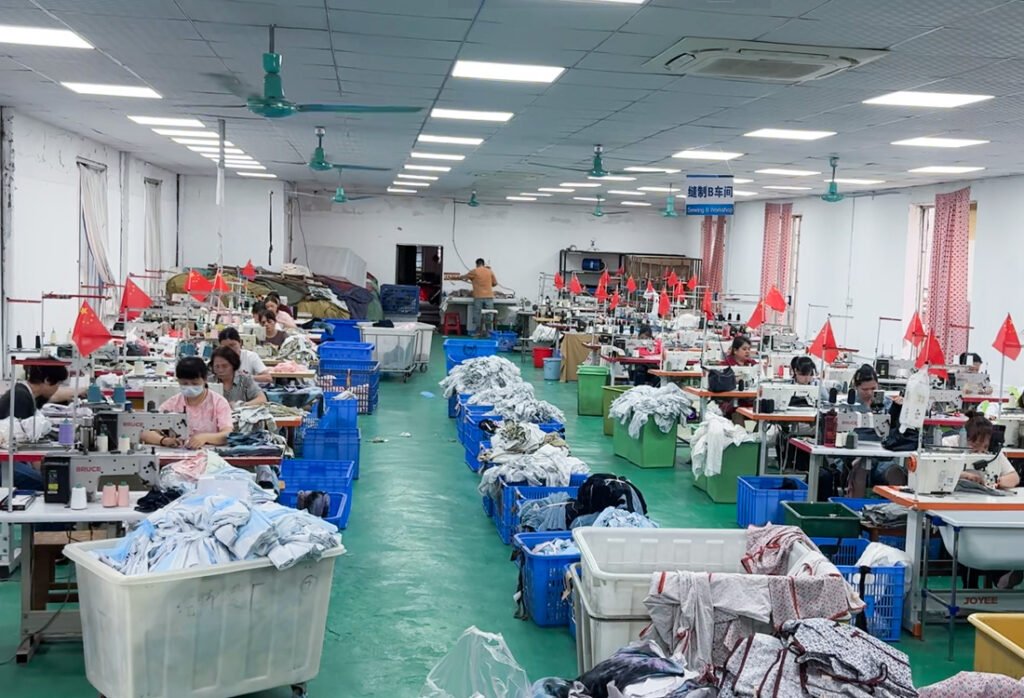
These problems may appear when the factory changes operators, rushes production, uses unsuitable machine settings, or fails to maintain a clear approved standard.
Low-price manufacturing sometimes depends on reducing production time or limiting inspection. This does not automatically mean that every lower-priced supplier produces poor quality, but brands should understand how the quoted price is achieved.
A slightly higher price may include better operator training, more careful fabric handling, in-process inspections, measurement checks, and final quality control.
These systems cost money, but they also protect the brand from larger problems.
4. Color Consistency Keeps Collections Looking Professional
Color is a major part of activewear branding.
Customers expect products from the same collection to coordinate. A black T-shirt should not look brown beside the matching shorts. Two navy products should not appear noticeably different under natural light.
Color variation may be caused by:
- Different dye lots
- Different fabric suppliers
- Fiber composition differences
- Changes in finishing treatment
- Incorrect color standards
- Lighting conditions
- Heat used during logo application
- Poor fabric roll management
Color matching becomes more complex when one garment combines different materials.
A training short may include a main stretch fabric, mesh panels, elastic, drawcords, zippers, thread, and a heat-transfer logo. These components may react differently to dyes and lighting.
A professional manufacturer should establish an approved color reference and evaluate the complete product—not only one fabric swatch.
For repeat orders, production teams should compare the new batch with the approved standard and previous products whenever possible.
Without this control, the brand may receive products that are individually acceptable but do not look consistent when displayed together.
This can create problems for product photography, retail displays, matching sets, and customer expectations.
5. Inconsistent Reorders Can Damage Successful Products
The first production order is not the only test of a manufacturer.
A reliable supplier must also reproduce the product months later.
Reorders are especially important because they usually involve styles that have already performed well in the market. The brand has customer reviews, sales data, product photography, size information, and marketing content based on the original version.
If the reordered product changes, the brand may face a serious problem.
The website still displays the original product. Existing customers expect the same fit and fabric. Influencers may be showing an earlier version. Retail partners may compare the new delivery with remaining stock from the first batch.
Reorder differences may include:
- Changed fabric hand feel
- Different fabric weight
- New color shade
- Altered measurements
- Different logo appearance
- Lower stitching quality
- Changed packaging
- Unapproved trims
A manufacturer may describe the new materials as equivalent, but customers may still notice the difference.
Stable reorder production requires accurate records.
The factory should retain or document:
- Final approved patterns
- Graded size specifications
- Fabric details
- Color references
- Approved samples
- Construction instructions
- Logo files and placement
- Trim specifications
- Label information
- Packaging standards
- Previous production notes
These references reduce the risk of treating every reorder as a new product.
AOLACORE states that its manufacturing system focuses on maintaining fabric quality, color matching, fit, sizing, workmanship, and packaging standards from the first sample through repeat orders. Its process also includes fabric inspection, pre-production sample approval, in-process checks, measurement verification, stretch-recovery testing, and final packaging inspection.
6. Poor Consistency Creates Costs Outside the Factory
The true cost of inconsistent production is spread across several parts of the business.
It does not appear as one clear invoice.
Returns and Exchanges
Customers may return products because the fit, fabric, color, or quality does not match their expectations or a previous purchase.
Customer Service
The brand must answer questions, investigate complaints, arrange replacements, and process refunds.
Warehouse Handling
Returned products must be received, inspected, repacked, restocked, discounted, or discarded.
Urgent Freight
If products need to be remade, the brand may have to use faster and more expensive shipping to meet a launch date.
Marketing Waste
Advertising may continue sending customers to a product with quality problems. Photography and creator content may also represent an earlier version that no longer matches the current inventory.
Lost Repeat Purchases
A disappointed customer may never complain or request a refund. They may simply decide not to order again.
This loss is difficult to measure because it does not appear in the return data.
Reduced Wholesale Confidence
Retailers and distributors need reliable sizing, colors, barcodes, packaging, and delivery quality. Inconsistent products can weaken future purchasing relationships.
When these expenses are included, the lowest unit price may become the most expensive manufacturing decision.
7. Consistency Makes Growth Easier to Manage
A small brand may be able to inspect every garment, personally answer every customer complaint, and manually correct inventory problems.
As order volume grows, this becomes more difficult.
More styles, colors, sizes, suppliers, warehouses, sales channels, and markets create more opportunities for inconsistency.
A stable manufacturing system allows the brand to scale without rebuilding the product standard for every order.
Consistency supports growth by making it easier to:
- Forecast return rates
- Plan inventory
- Reorder successful products
- Expand color ranges
- Add new sizes
- Develop matching collections
- Work with retailers
- Enter new markets
- Maintain customer reviews
- Build long-term supplier relationships
This does not mean that products should never change.
Brands can improve fabrics, fits, construction, or packaging. However, changes should be intentional, tested, documented, and clearly introduced.
Unexpected variation is the real problem.
8. Low Prices Can Limit Product Development
A quotation may be lower because the supplier is using an existing fabric, simplified construction, standard packaging, limited quality inspection, or a material available at a temporary discount.
This may be suitable for some products and price positions.
The problem occurs when the brand expects premium performance at a price that cannot support the necessary materials and production controls.
For example, a premium training short may require:
- A stable four-way-stretch fabric
- Strong recovery
- Accurate pattern development
- Reinforced stress points
- Functional pockets
- Durable logo application
- Multiple measurement checks
- Reliable color matching
- Careful finishing
Removing these elements may reduce the quotation, but it may also change the product.
Brands should therefore ask what is included in the price.
A useful quotation should clarify the fabric, GSM, construction, logo method, packaging, quantity, quality standard, and other important requirements.
A very low quotation based on incomplete specifications is difficult to compare with a detailed quotation based on an approved product standard.
How to Evaluate Manufacturing Consistency
Before selecting an activewear manufacturer, brands can evaluate consistency by asking several practical questions.
Can the Factory Explain Its Sampling Process?
The manufacturer should be able to explain how fabrics, patterns, measurements, logos, trims, and packaging are confirmed before production.
Does It Use a Pre-Production Sample?
The final approved sample should become the reference for bulk manufacturing and inspection.
How Is Fabric Controlled?
Ask how the factory checks fabric weight, color, surface defects, stretch, recovery, shrinkage, and dye-lot variation.
When Are Measurements Checked?
Measurement control should happen during production as well as during final inspection.
How Are Repeat Orders Managed?
Ask which specifications, patterns, samples, colors, and production records are retained for future orders.
What Happens When a Problem Is Found?
A professional manufacturer should have a clear process for identifying, correcting, reinspecting, and documenting production issues.
Price remains important, but these questions reveal whether the supplier can protect the product standard behind that price.
How AOLACORE Helps Maintain Consistent Activewear Production
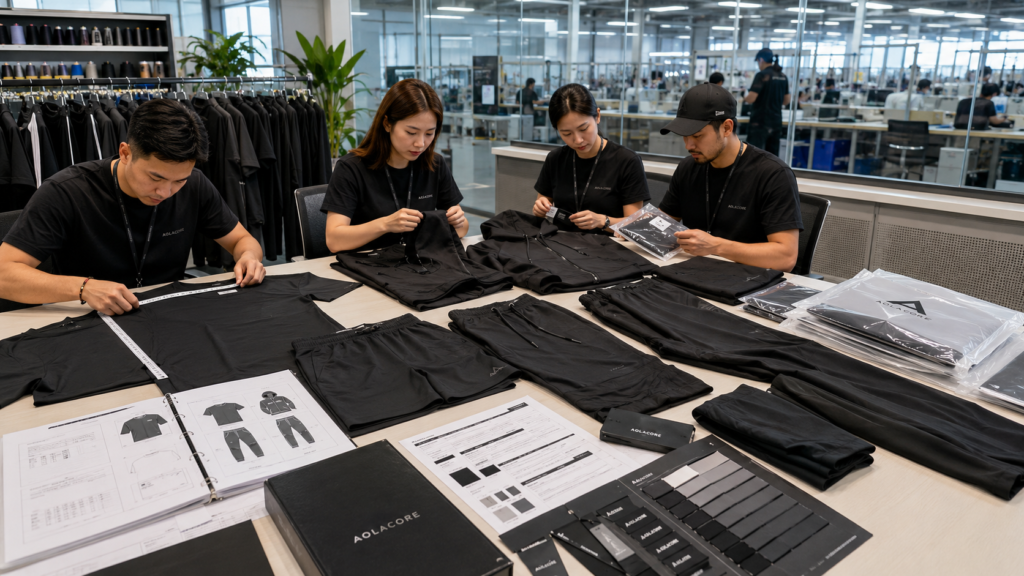
AOLACORE supports brands through a connected development and manufacturing process that includes fabric sourcing, pattern development, sampling, pre-production approval, bulk manufacturing, quality inspection, private-label packaging, and shipment preparation.
Before production, the team works with brands to confirm:
- Fabric specifications
- Product measurements
- Fit requirements
- Construction details
- Logo application
- Labels and trims
- Color standards
- Packaging requirements
- Approved production samples
During manufacturing, inspections are performed at key stages such as fabric preparation, cutting, sewing, logo application, measurement checking, finishing, and packing.
For repeat orders, the objective is to maintain the characteristics that made the original product successful, including fabric feel, fit, sizing, workmanship, color, branding, and packaging.
This structured process helps brands reduce avoidable variation between samples, bulk orders, and future production batches.
Final Thoughts
The lowest manufacturing price can reduce the cost of one purchase order.
Consistency can protect the entire business behind that order.
Customers do not judge a fitness apparel brand by its factory quotation. They judge the fabric, fit, comfort, appearance, durability, and reliability of the product they receive.
When those qualities change between garments or production batches, customer trust becomes harder to maintain.
A consistent activewear manufacturer helps the brand deliver the same product promise repeatedly.
That can lead to fewer complaints, more dependable reorders, stronger reviews, improved customer retention, and more stable growth.
Price should always be evaluated.
But instead of asking only:
“Which manufacturer offers the lowest unit cost?”
Brands should also ask:
“Which manufacturer can reproduce our approved quality consistently?”
In activewear manufacturing, the supplier that protects product consistency may create far greater long-term value than the supplier offering the cheapest initial price.
Build a More Consistent Activewear Collection
AOLACORE supports men’s activewear brands with fabric development, customized sampling, OEM/ODM manufacturing, private labeling, bulk production, multi-stage quality control, packaging, and repeat-order management.
Whether you are producing training T-shirts, shorts, hoodies, joggers, compression wear, or a complete fitness apparel collection, stable manufacturing standards can help protect your brand as it grows.
Are you looking for reliable manufacturers of clothing products?
We can quickly provide customers with market analysis, technical support and customized services.